Posts

Critical Feedback Form
Image
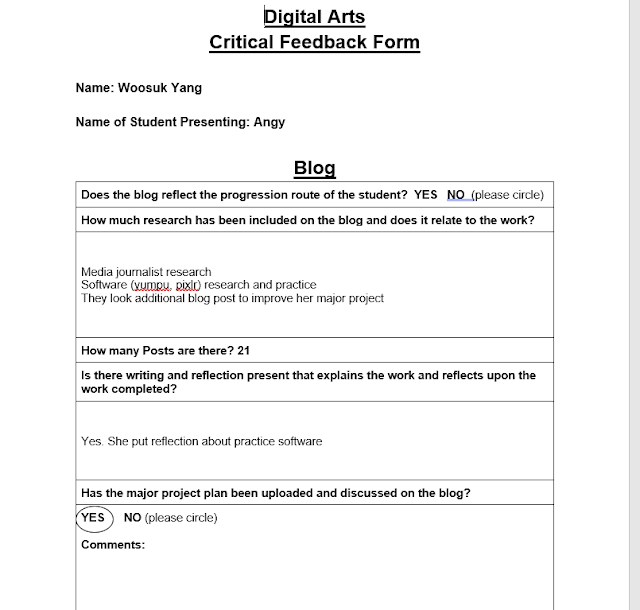
Woosuk and I have filled out a feedback form regarding each others blogs and websites. This is the feedback I have received. I agree on the fact that my blog does not reflect my progression route in terms of layout and I will work on that, however the blog's name includes the word "News" suggesting journalism or media.  I did complete research and started working on my article and posted it on my blog. I think Woosuk misunderstood the blog for the website  I am missing an introduction for the major project, which I am working on at the moment. The introduction will be displayed in the gallery page above the major project. The website does not look welcoming perhaps because of the lack of the introduction and images, however the website of a journalist should not be as eye-catching as an architecture or photography website. My article will have photographs that I shot and edited.
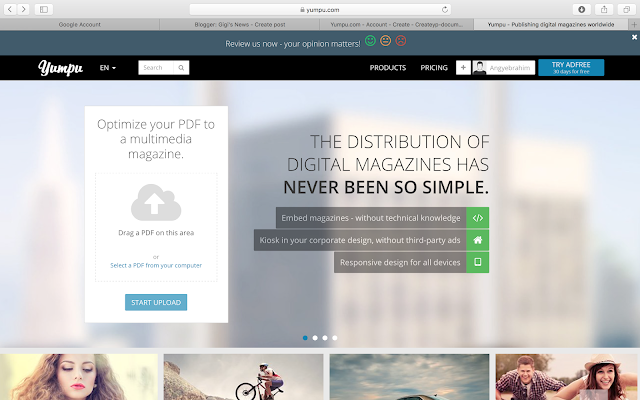
Flip book practice

Image
I had a look at Yumpu today on how to create a flip book for my article. I began by creating an account on yumpu.com I pressed on the little cross sign next to my name on the right top corner.   3.  Click on 'select file to upload' must be a PDF .This option does not work at the moment because  I have used my 3 free practices but this is how I did it. I will create a new account for future use. 4. I have uploaded a PDF document found on my laptop and after a few seconds the document developed into a flip book.     The file can then be downloaded as shown by the screenshot I took         Source:               yumpu.com 

Draft on Introduction of Article

Image
After completing my interview with Bettina Downing, I created an introduction draft for my article. (This is my first attempt and I still have to work on it) According to (Reeves and Keeble, 2014), there are many ways to start a feature news article. The examples mentioned in the book are: The case-study intro Quote intro Eye-witness intro The news intro Historical  background Intro Striking contrast into  The personalized intro Question intro The narrative intro  In this case I have used a "Question Intro" starting off my article with a question.   I have written my draft before consulting this book and this book give me proof that I was on the   right track. I also included a peg in this introduction, also referred to as 'hook'.  The 'peg' or 'hook'  "explains why this particular piece is relevant to the audience, and why it is relevant now" (Reeves and Keeble, 2014)  In other words, it wants to give the audience a pu...

Further Software Practice

Image
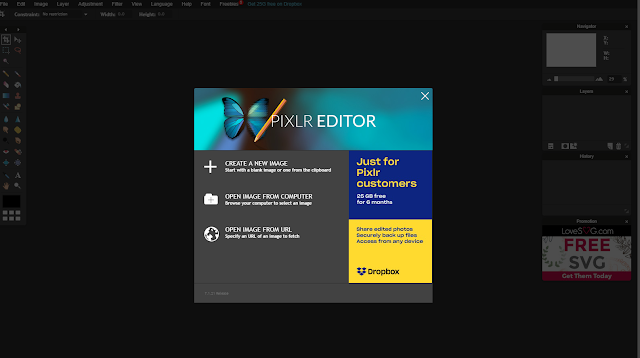
I have looked at Pixlr as a second software option to broaden my choice; however for several reasons I have decided to continue my work with Lightroom. Firstly, I created an account on Pixlr.com and started editing an image which I downloaded from Unsplash choosing the option  "open image from computer"  I started editing the picture, clicking on "Adjustment" followed by Brightness and Contrast. Pixlr offers many tools that might come in hand, but one main reason for which I think that Lightroom is a better option is when deciding to withdraw your action. Meaning that, if we consider Lightroom, a double click on the adjustment bar of any type of editing feature such as saturation, will return the photograph to its initial state. Pixlr, on the other hand, does not include this feature but  it allows you to delete an undesirable layer as illustrated on the right-hand corner. In my opinion, Lightroom's  feature is the most suitable because it gives me ...

Interview Transcription

Interviewer: Angy Ebrahim Interviewee: Bettina Downing Thursday, 13th of February 2020  -12:30 pm - Art Factory room 0.04 Angy:   It is often believed that media help in controlling and fueling conflicts. Do you think that media, with the use of language, should not report actual facts and casualties that may occur in a given conflict because of the fear that these facts might fuel the conflicts? Do you think there should be such bias in their reportage? Bettina:  I think it is very important that audiences do perceive that writers are using factually accurate information and that they can trust and rely on the details they are given. I think audiences dislike reading texts where they feel they are being lied to or the information is incorrect, so I think that the issue is not actually the use of facts or reporting the number of casualties, but I think there is definitely an issue in the language of reporting about war and conflict and that is in some of the word c...

Software Practice

Image
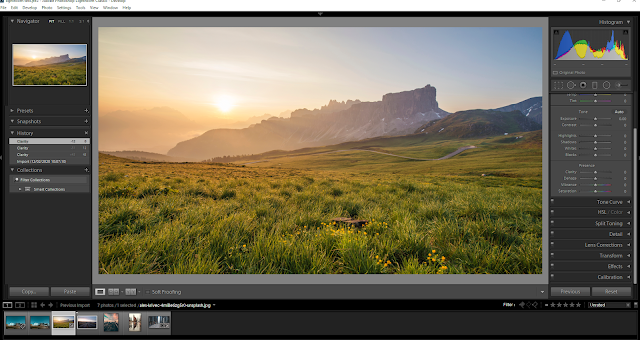
For my major project, I chose to rely on the Lightroom Classic from Adobe. At first, the software seemed complicated as I have never used photoshop before, but with some practice I realized how it works. My only challenge was that I couldn't export the images I wanted to test for some reason so I asked for help to my tutor and he explained that the problem was that the images should be placed in a folder and advised me to use a USB stick when I eventually need to edit my photographs from the interview. The program has many features for editing the light within photographs such as contrast and highlights. It also includes the graduated filter, which enables you to make part of the image darker by placing a filter mask on the part you choose.     More tools are present to choose from such as the Spot Removal tool and the Vignette, the spot removal tool helps in eliminating unwanted flaws and the vignette helps to draw attention to the center of the image. A list of ...

Further research on Media and Journalism

Image
While searching for books related to my progression route on the DMU library I came across " Feature and Narrative Storytelling for Multimedia Journalists " by Duy Linh Tu. This book focuses on the techniques of multimedia and documentary production used by journalists. In part 3 of the book, the author explains the use of the inverted pyramid in journalism and how this technique is not suitable for a narrative writing or feature article. In the inverted pyramid, the first part is regarding the most important information, followed by other details and ending with the background. "For news or alerts, readers want the most important information immediately, right at the top of the story." (Tu, 2015, p198). On the other hand, feature or narrative writing do not have the most relevant information at the beginning. As (Tu, 2015) suggests feature videos and narrative documentaries build up a climax. "When watching a feature video story, viewers must stay to the ...